Thanksgiving gatherings can increase kitchen-drain use in a Willow Park home. A household that normally runs one dishwasher cycle a day may suddenly run several, with three people at the sink, a disposal working through vegetable trimmings, and a roasting pan that somebody rinses without thinking about where the drippings go. Willow Park is a small, mostly residential community strung along the I-20 corridor, and the housing here is exactly the kind that shows this pattern clearly: family kitchens on standard residential drain lines that behave perfectly at normal load and then back up at the worst possible hour. This guide covers what actually goes wrong, what you can safely handle yourself, how to tell whether the problem is the disposal or the drain behind it, and why the store-bought chemical route usually makes things worse rather than better.
What a Garbage Disposal Is Actually For
A disposal does not have blades. It has two swiveling impellers on a spinning plate that fling waste outward against a stationary grind ring, which shreds it into particles small enough to wash away. That design handles soft, wet, biodegradable scraps in small quantities with plenty of cold water running. It does not handle anything fibrous, anything starchy and expandable, anything that turns to paste, or anything hard.
The practical list of what should never go in:
- Grease, oil, butter, bacon drippings, and pan fat in any amount
- Potato peels, and especially large quantities of them, because starch turns into a glue in the trap
- Celery, corn husks, artichoke leaves, onion skins, and other stringy material that wraps the impellers
- Rice and pasta, which keep absorbing water and swelling after they pass the grind ring
- Coffee grounds, which pack into a dense sediment in the trap and the horizontal run
- Bones, fruit pits, and shells
- Eggshells, despite the persistent myth that they sharpen something
- Paint, patching compound, or anything that cures
Follow the disposal manufacturer’s instructions for water flow, suitable scraps and operating time. Feed small amounts gradually rather than packing the chamber. Keep grease, oil and fat out of the drain regardless of water temperature; cold water does not make grease disposal safe.
Grease Is the Real Culprit, Not the Disposal
When we open up a kitchen line that has been clogging repeatedly, we rarely find a single object. We find a hardened layer built up along the inside of the pipe, thickest on the bottom of horizontal runs, narrowing the line from the inside until the effective diameter is a fraction of what it should be. That layer is grease plus food particles plus soap scum, accumulated over months or years.
This is why the timing of holiday backups is not a coincidence. The line was already narrowed. The extra volume of Thanksgiving week is simply the first demand the pipe cannot meet. A drain that is becoming progressively slower is a reason to arrange an assessment before hosting.
Handling grease is straightforward and it is entirely on the cook, not the plumbing. Pour cooled fat into a can or a jar and throw it in the trash. Wipe greasy pans with a paper towel before they go in the sink. Scrape plates into the trash rather than the disposal. Run a strainer basket and empty it. None of this is glamorous and all of it works.
Safe Things You Can Do Yourself When a Disposal Quits
Before inspecting a disposal, switch it off and disconnect power according to the model's instructions. Never put your hand in the chamber. Do not touch a wet plug or enter a wet cabinet to reach electrical controls. Leave the unit off if you cannot confirm safe isolation.
Work through this sequence.
- No sound: record whether the unit has stopped completely. Follow the model's instructions for an external reset only from a dry, safe location; silence can have several causes.
- A reset that will not hold: leave the unit off. Repeated resetting is not a repair and may conceal a fault.
- A hum without grinding: stop the motor. Some models permit a manufacturer-specified external unjamming tool after power is disconnected. Do not improvise with a broom handle, reach into the chamber, or assume every model has the same socket. Call if the instructions or safe isolation are unclear.
- The motor runs but water does not drain: stop adding water and record whether another basin or appliance also backs up.
- Leakage: note the visible location without handling wet wiring. A fitting, sink flange, or disposal body may need a different repair; the location is evidence, not a diagnosis by itself.
- Unusual metal noise: switch off the unit and arrange a safe inspection. Continuing to grind can worsen damage.
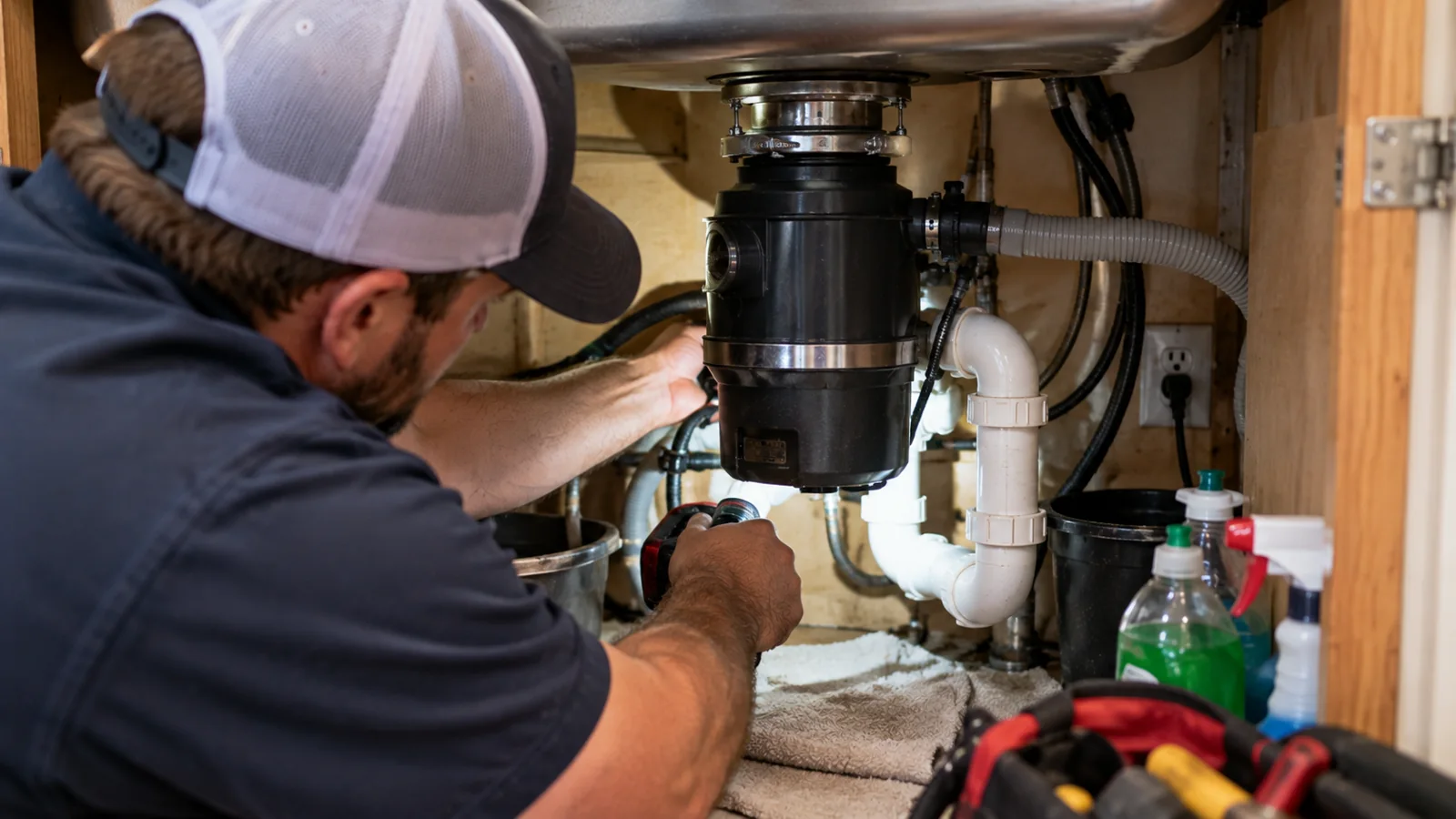
Restore power only after the manufacturer-specified procedure is complete and the area is safe. If the unit trips again, leave it off and arrange an inspection rather than assuming the motor has failed. Disposal installation is part of our residential plumbing work, along with sink and fixture plumbing.
Telling the Disposal Apart From the Drain
This is the distinction that determines whether you need a new appliance or a clean line, and homeowners get it wrong in both directions all the time.
Signs the disposal is the problem:
- It hums, trips, or does nothing while the other side of the sink drains normally
- Water backs up only on the disposal side
- The noise changed suddenly after something hard went in
- Water appears under the unit and not at any joint in the pipe
Signs the drain is the problem:
- Both sink basins drain slowly, or one fills when the other runs
- The disposal spins freely and still will not clear water
- The dishwasher backs up into the sink
- Gurgling from the sink when the washing machine drains, which points further down the line
- Any other fixture in the house is also slow
That last set matters most. If a kitchen sink is slow and a bathroom is slow and a toilet is gurgling, the problem is not under the sink at all. It is in the branch line or the main sewer line, and replacing a disposal would be an expensive way to change nothing. Our sewer line services cover camera inspection, mechanical cleaning, and repair when the trouble is out past the house.
Why Store-Bought Chemical Drain Cleaners Are the Wrong Tool
Drain-cleaner formulations differ, and some can damage materials or create hazardous residue. Do not mix products, add another chemical to a treated drain, or assume a temporary improvement has removed the underlying obstruction. Tell the plumber exactly what was used before work begins.
Three specific problems with the chemical route:
- Some products can damage plumbing materials or seals when used incorrectly.
- A temporary improvement does not establish that the underlying obstruction has been removed.
- Chemical residue can create a hazard for anyone opening or clearing the line.
A plumber can assess the blockage and pipe condition before selecting a suitable mechanical or hydraulic cleaning method.
Snaking, Hydro-Jetting, and Camera Verification
A cable machine, or snake, cuts and pulls. It is the right first tool for a discrete obstruction: a solid object, a hairball in a bathroom line, a root mass that needs cutting. It punches a hole and drags material out, and for many kitchen clogs that restores flow immediately.
Hydro-jetting uses pressurized water and specialized nozzles to remove suitable buildup. Snaking or jetting may be appropriate depending on the obstruction and pipe condition. Neither method guarantees a fixed number of weeks or years of trouble-free drainage, and cleaning cannot repair a damaged or incorrectly sloped pipe.
There are judgment calls. Very old, corroded, or already compromised pipe may not be a candidate for full-pressure jetting, and that is a decision made after looking, not before. Which brings up the part most homeowners never see: we run a video camera inspection after cleaning to verify the line is actually clear and to check the condition of the pipe. That post-clean inspection is how you find out whether you had a grease problem, a belly in the line holding water, a broken section, or roots at a joint. Without it, you are guessing.
Our drain cleaning services cover kitchen drains and garbage disposals, bathroom and floor drains, main sewer line clearing, hydro-jetting, snake clearing, and post-clean camera inspection.
Getting a Willow Park Kitchen Ready for the Holidays
Two weeks before you host is the right window. That leaves time to deal with whatever you find.
- Fill both basins with cold water and release them at once. A drain that handles a full-load surge without backing up is in reasonable shape. One that burps or slows is marginal.
- Time the drain. Water should disappear with a steady pull, not a lazy swirl.
- Run the dishwasher and watch the sink. Any water rising in the basin means the shared line is restricted.
- Listen for gurgling anywhere in the house when a large volume drains. Gurgling is air getting pulled through a trap because the line or the vent is partly blocked.
- Check under the sink for moisture, corrosion at the slip joints, or a sagging trap arm.
- Test the disposal under load with cold water and something soft. Note any new vibration or rattle.
- If your household has been putting off a slow drain since summer, deal with it now rather than during a holiday week.
If any of those checks come back wrong, schedule the work while it is still elective. Call the office to confirm current appointment availability. The Weatherford office covers Willow Park and the rest of Parker County at (817) 599-8765.
Willow Park Along I-20: Homes and the Businesses Around Them
Willow Park is small and mostly residential, sitting right on the I-20 corridor between Fort Worth and Weatherford. That shapes the work in two ways.
For households, it means fairly standard residential drain configurations, which is good news: kitchen line problems here are usually solvable with proper cleaning rather than reconstruction. It also means houses that fill up with visiting relatives at the holidays, which is exactly the load condition that exposes a narrowed pipe.
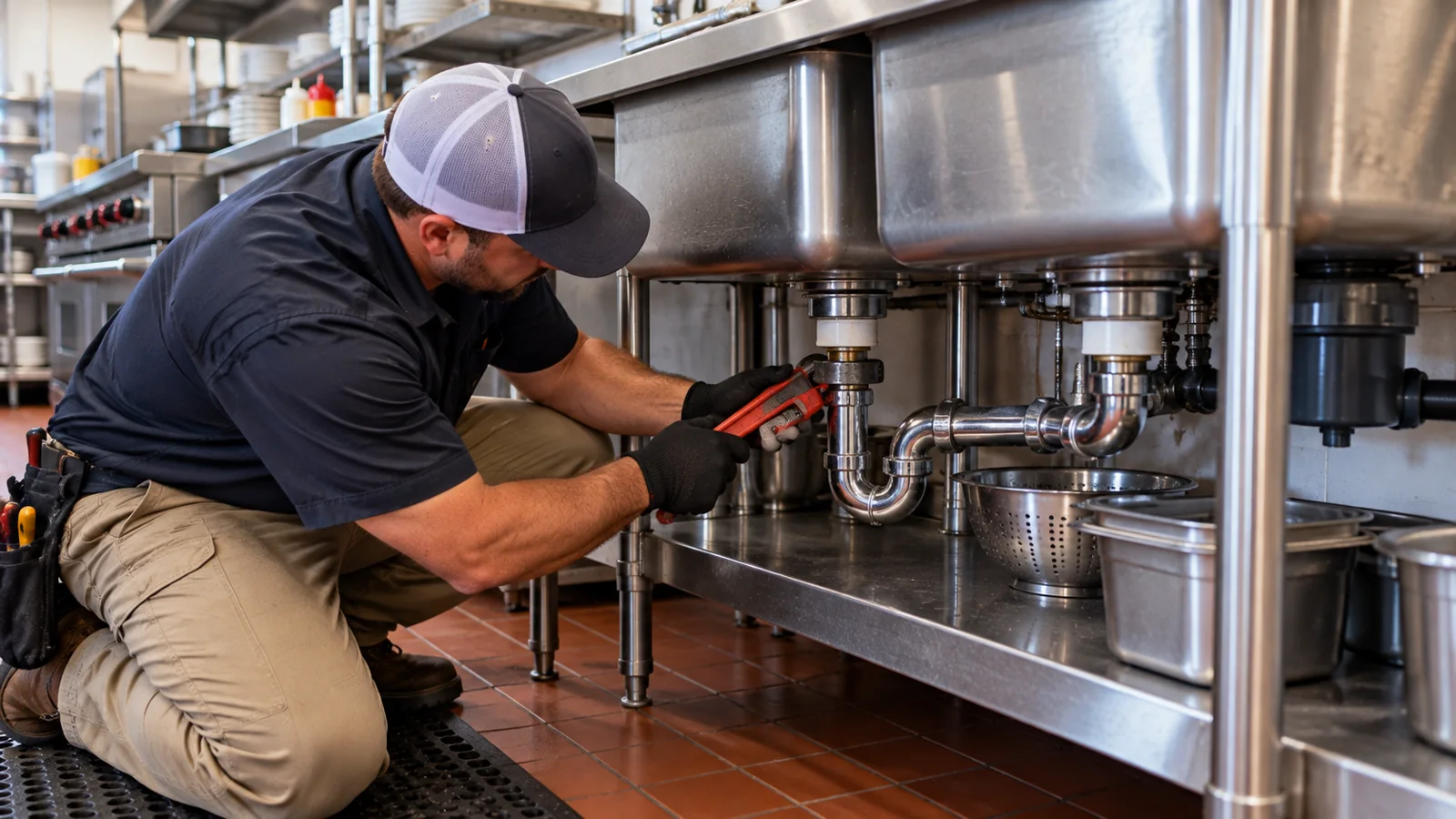
For the businesses along the corridor, grease and drainage management can involve heavier use and different equipment. Restaurants and any operation with a commercial kitchen deal with grease traps, kitchen floor drains, and mop sinks that may need a planned maintenance program suited to the equipment and use. A holiday-season backup in a restaurant is a closed dining room. Our commercial plumbing work covers grease trap installation, cleaning and repair, hydro-jetting of kitchen floor drains and main lines, backflow preventer installation and annual testing, and Texas code compliance. Preventive maintenance programs for restaurants and commercial kitchens exist for exactly this reason.
You can see the full scope of what we handle locally on our Willow Park service area page.
When a Kitchen Backup Becomes an Emergency
Most slow drains can wait for a scheduled appointment. Some cannot.
Call immediately if sewage is backing up into a tub, a shower, or a floor drain, because that means the main line is blocked and every fixture in the house is now feeding a closed system. Call immediately if water is overflowing and you cannot stop it, if multiple fixtures stopped draining at once, or if you have a blocked toilet in a house full of guests and no second bathroom.
We run 24/7 emergency service, including weekends and holidays, which covers Thanksgiving itself. Main line backups, sewage backup cleanup, sewer line clearing, and blocked toilets are all part of our emergency plumber service.
While you wait, stop using water everywhere in the house. Every flush and every load of laundry adds to what is already backing up. Stay out of standing water near electrical equipment; isolate power only from a dry, safely accessible location.
Repair, Clean, or Replace: Being Honest About It
A disposal that jams once and clears is a disposal that needs better feeding habits, not a replacement. A disposal that trips its overload weekly, leaks from the bottom housing, or has lost grinding capability is at the end of its service life, and putting labor into it is throwing effort after a worn motor and a worn grind ring.
A recurring blockage deserves an assessment rather than repeated clearing without investigation. The appropriate next step may be cleaning, camera inspection or repair, depending on the obstruction and condition of the pipe.
We hold Texas Master Plumber License M-37011 and work as a licensed and insured plumbing contractor in Texas. We also provide free estimates on most non-emergency plumbing projects, so having a marginal kitchen line looked at before the holidays is a reasonable thing to schedule.
Frequently Asked Questions About Kitchen Drains in Willow Park
Why does my garbage disposal hum but not spin?
A hum without grinding may indicate a jam, but it is not a complete diagnosis. Switch the disposal off and disconnect power before any inspection; never put your hand into the chamber. Follow the exact model's instructions, and do not assume every unit has an accessible hex socket. If you cannot confirm safe isolation or the unit keeps tripping, leave it off and call for service.
My Willow Park kitchen sink keeps clogging even after I clear it. Why?
Recurring clogs can have several causes, including buildup, an obstruction, a low spot or a damaged section. A professional assessment and, when appropriate, camera inspection help determine whether cleaning or repair is needed.
Are chemical drain cleaners safe to use before Thanksgiving?
Avoid adding drain chemicals before a service call. Formulations differ, some can damage materials, and residue can endanger anyone opening the line. Do not mix cleaners; tell the plumber the product name and when it was used.
Can I run my disposal while the dishwasher is going?
Follow the dishwasher and disposal manufacturers’ instructions for your installation. Do not assume that every dishwasher connects through a disposal or that one operating rule fits every setup. If water backs up into the sink, stop using the affected fixtures and arrange an assessment.
Do you offer emergency drain service in Willow Park on Thanksgiving?
Yes. We run 24/7 emergency service including weekends and holidays, covering plumbing repairs for main line backups, sewer line clearing, and blocked toilets. Calling the Weatherford office directly at (817) 599-8765 is the fastest way to reach us.
How do I know whether the problem is the disposal or the drain line?
Test the other basin. If the non-disposal side drains normally and only the disposal side backs up, the unit or its discharge is the issue. If both basins are slow, the dishwasher backs up, or other fixtures in the house gurgle or drain slowly, the drainage system needs assessment; these symptoms alone do not identify the exact fault.
Topics